
Fort Exmouth

Cafe Locked Out On The Road; In search of who we actually are.

We’ve found one edge of the real estate frontier. It’s near the tip of a peninsula and the corellas, cracking, are letting us know that we were officially inside Fort Exmouth.
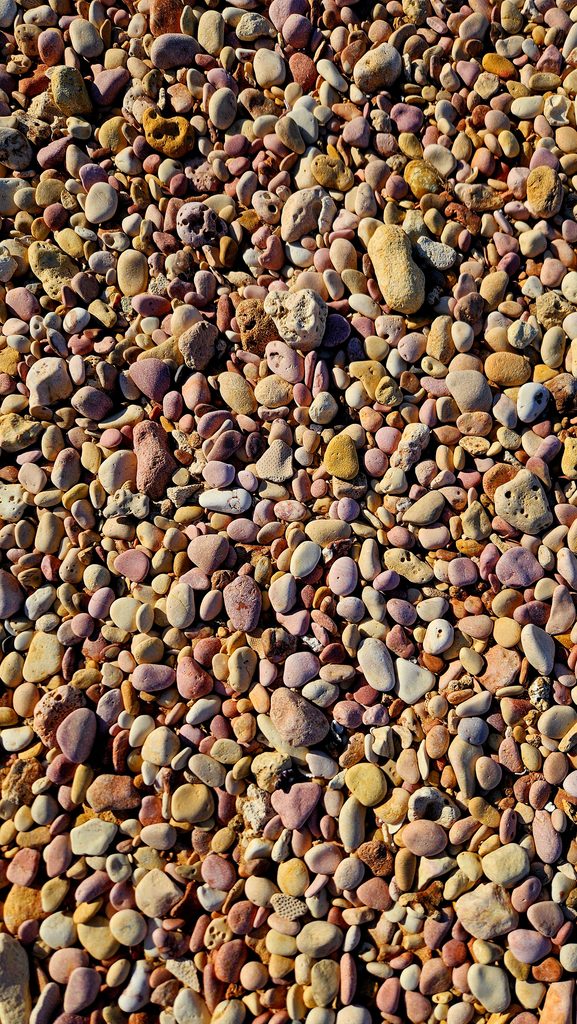
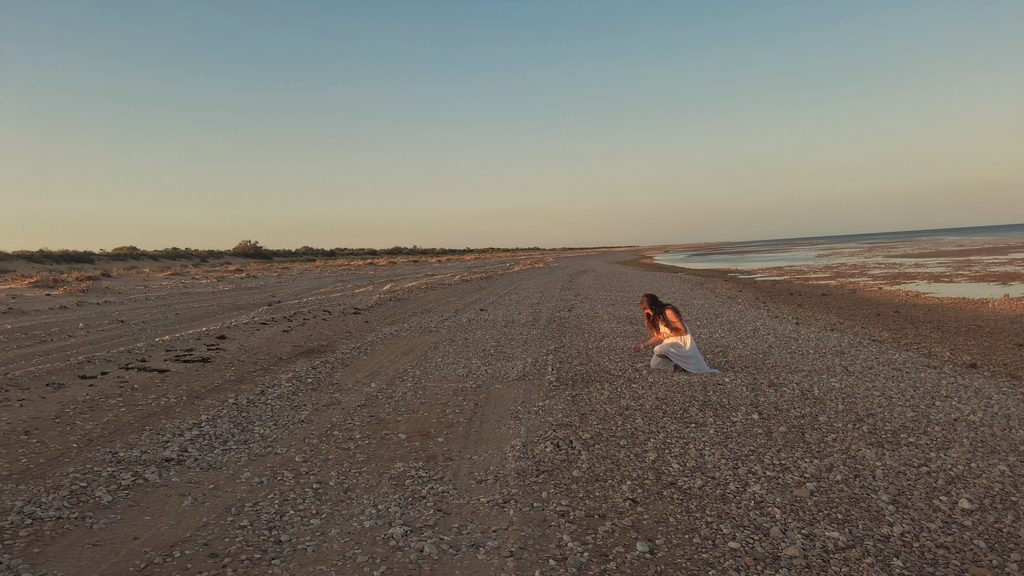
We’ve been living on a remote beach near Learmonth for two days. A beach covered not with sand but smooth and mainly washed-out pink pebbles.
We bathed in the sea and then, with a four-pronged aluminium spear that, over forty years ago, my snorkelling father caught a fish with. It was a big fish, which explained his big smile. I wasn’t on that holiday, but I know that he fed those who were there with that fish.
Now it was my turn.
In my soul I felt like the ancient hunter was returning, but in the mirror, which I’m glad we didn’t have, I felt that I looked like an old homeless person wading through warm knee-high water carrying a broken section of a forgotten antenna.
The best chances we had of a good feed were stingrays. They kept erupting in an underwater cloud of dust then flying off just out of reach.
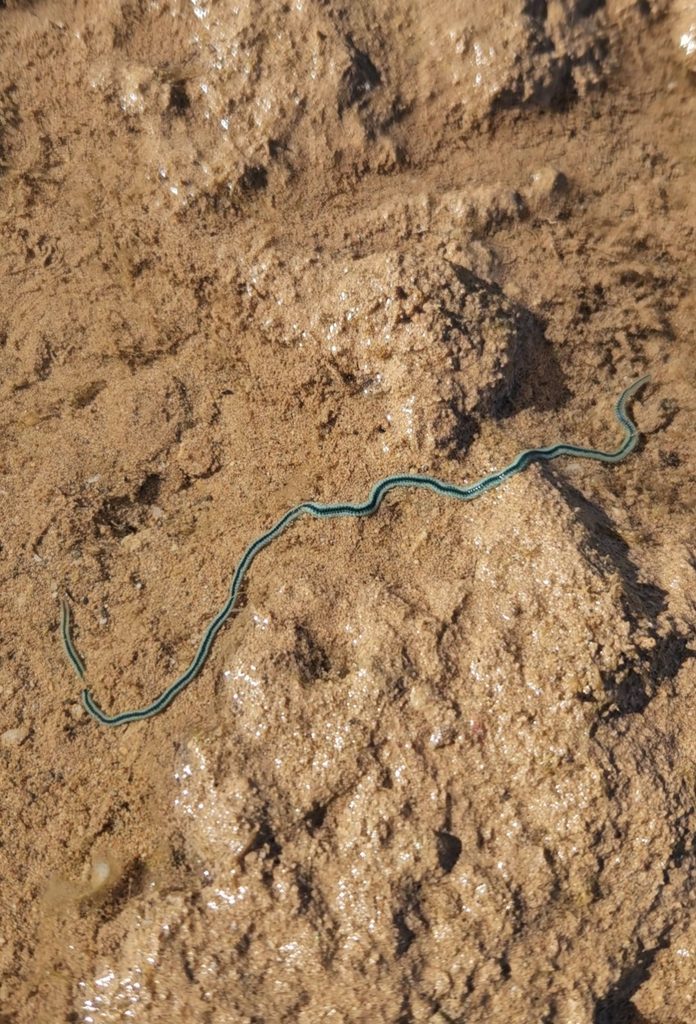
This creature, whatever it is, looked far to fragile to exist here, but it was thriving.
Can you eat stingray?
I didn’t know. And I didn’t have my phone—and if I had, I didn’t have an internet connection to ask Grok.
I was alone.
Half an hour before that I was wearing a mask and snorkel and floating over the shallows, and most of this beach was shallow, with my dad’s spear at the ready.
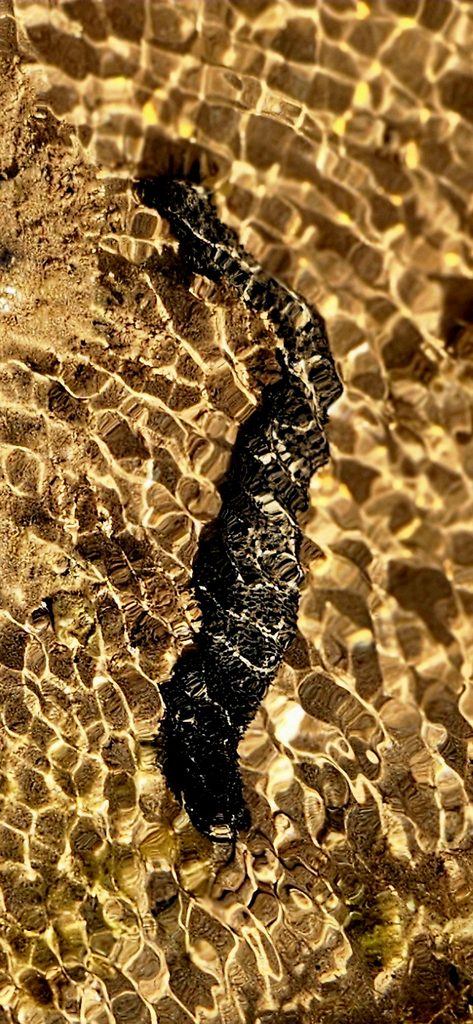
Adrift, I floated above dozens of motionless black sea slugs wrapped around grimy rocks, and thought they are what the Indonesian fishermen risk their lives and/or getting arrested for. Apparently these are a delicacy in Jakarta.
Well they could have them, for in this hobby-level exploration to see if we can live off the land, neither of us has reached the prepared-to-eat-a-slug stage, especially a slug that looks like a black poo.
At one point I’d decided that it would be prudent to have some target practice so that if I did see a big fish I would have a chance of spearing it. So I picked out a lump of sand and bang—not only was I bang on but I had inadvertently speared a crab. One very pissed-off crustacean who I was considering letting go, which in itself was an awkward proposition, for even if he hadn’t been impaled by one of my barbs, currently the poor bastard was determined to use his claws on me. Which I fully sympathised with.
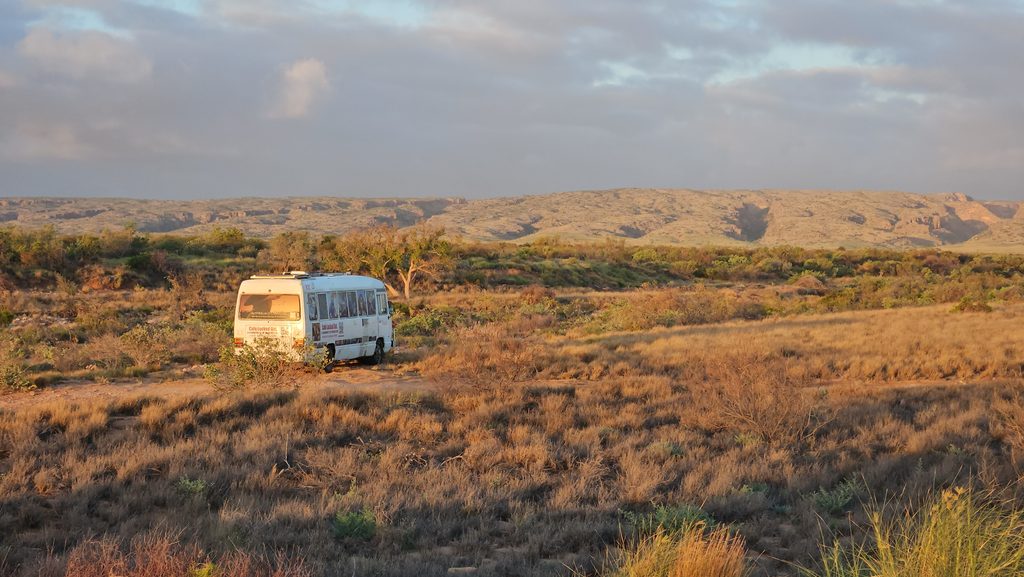
After he was dead we boiled and then ate him and both agreed that it was fortunate that we had other food in the bus.
Later, as I continued to pretend that I was transitioning into Alby Mangels, a small reef shark came within a few metres of me before swimming back to the depths to file a report, and later that day a sea turtle came even closer. I gazed upon him in awe. He or she lifted their head with a degree of elegance that was immediately lost when he saw me and did a very fast, awkward water U-turn, before desperately splashing back to deeper water.
Kel Beachcombing.
Obviously the memories of man were deep in his ancestral DNA, whereas me, with every hour that passed, I became ever more astounded at how the black people not only managed to live out here but how they supported small tribes.
For even though it was clear that life was everywhere—going from the myriad of tracks criss-crossing the sand between the pebbles, including lots of snake tracks—on land we never saw anything alive, nor did I fancy our chances of finding water. Which was why we had to leave and come here to Fort Exmouth.
Fifty-five years I’ve lived in this country. And while I have spent a lot of time in the bush, mainly as a kid, here it was clear that outside of our system of roads and supermarkets I was a tourist. A fragile one.
Exmouth feels like a frontier town. It states this itself on a government building: this is one of the most remote places on earth.
The tallest trees are palm trees and the other trees are short, stunted, even emaciated. It’s not shade that makes modern human habitation possible out here, it’s air conditioning.
Exmouth was established in the mid-1960s specifically as a support town for the United States Naval Communication Station Harold E. Holt.
It is as old as me.
But where I now have scars from heart surgery and motorbike accidents, it has built marinas whose shores are populated by Sydney-like mansions. Each with their own personal mooring. At a glance you could think you were in an exclusive waterfront estate in Miami, Florida.
We wondered what the people did for work here, in order to not only afford to buy one of these mansions but to service it. For when we were in town all the shops were being managed by European tourists on work visas, with a scattering of a few old white Aussies who did not look like they were getting paid enough to save up for a boat to moor at their personal marina.
Andrew, who follows us, was up here from Carnarvon.
He stopped to talk and told us that when the mandates were enforced he lost his job in the airport and his partner lost her job too, which is why they had to leave.
Even when both of us were working full time we struggled to make ends meet, so once we were unemployed there was no chance. It’s just so expensive to live here.
Carnarvon is way cheaper, he said.
He went on to say he couldn’t do an interview because he couldn’t risk anyone in Carnarvon recognising him. Everyone is jabbed down there. You don’t talk about it. Whereas up here, I’d say half the town didn’t take it, and you can’t talk about that either.
Then, when his wife, who never stopped to say hello, called out and after telling us he had to go, he was gone.
I wonder if this was why, six years ago, when Dan Andrews said, we are now a vaccinated economy, you are either in or out, so many complied, many against their will?
I personally have experienced grown men privately crying with me as they claimed they felt that when they were being inoculated, that they were actually being medically raped.
So was Dan simply clarifying that the only reason we can exist here; that we can go doom scrolling through our days, is because they had built a life support system for us, in an inhospitable country, that without access to their shelter, would kill us.
We call it civilisation. A system that in 2022 they declared now requires an additional fee in order to remain.
Roll up your sleeve, tourist, or we will cancel your visa.
For whilst we may have a few survival experts in our midst, most of us city folk have never killed, gutted and then cooked a kangaroo or dug down to drinkable water in a bone-dry river bed.
Basically, we could be seen as colonising astronauts, flying around our busy streets in our now driverless cars which are fully air-conditioned, as experiencing the heat of the Australian summer becomes an optional extra that most of us decline.
Exmouth is a prime example.
Once there were just rocks here, covered in sparse and tough vegetation.
Now they have sanitation and bottle shops. Now they have traffic lights and a craft-beer brewery that also has a karaoke room. Now it has cycle paths.
When we were in Waroona, we sat in the bush around a large camp fire, as four Indigenous elders cooked kangaroo tails that they’d bought from the local IGA. The tails were sealed in Glad Wrap and still had barcodes.
They told us, as the flames danced, that they saw the bush as their mother and their mother’s larder was abundant. All you had to do was read her signs.
They never told us what these signs were, but I wonder how we would all feel, as a people, if we could read them too?
How we would feel if we saw this country not as resource-rich land that we were lucky to acquire, or rather steal, but as our mother.
Goodbye Road, Michael’s first critically acclaimed novel is available here
Imagine a time where, if a child went missing in the bush we didn’t lose our shit, because we knew that they knew how to find water, even food. A time when we weren’t scared of being lost in the bush, because it was our mother’s bush.
I wonder too, if the powerful would find it harder to shame us with their Welcome to Country ceremonies, or control us with their fear, if we all knew we were already home, and because of this, we also knew who we were.
We are the children of our mother, Australia.
A mother who loves waking us all with the exuberance of the corellas. A mother who wants to see what we can build with all our dreams and ingenuity, on the canvas of her vastness.
For despite the disconnection, we are an adaptable and impressive race.
If we were to be wiped out tomorrow, how long would this land have to wait for another species to arrive and build homes on this dry and rocky peninsula?
Michael Gray Griffith
Exmouth 17/11/.26
Images Kelli Stevenson


Discover more from The Defiant Cafe, Cafe Locked Out
Subscribe to get the latest posts sent to your email.
Love your adventures and the photos are amazing XXX