
Do 12 Brussel Sprouts mark the end of our Golden Era?

“I have never been racist, but this Government is making me racist.”
I was cooking dinner for Kelli and me in the town of Burra, in South Australia. Most of the travelling folk, in their matching four wheel drives and caravans, were ignoring us, as per usual, but then one man in his forties came up.
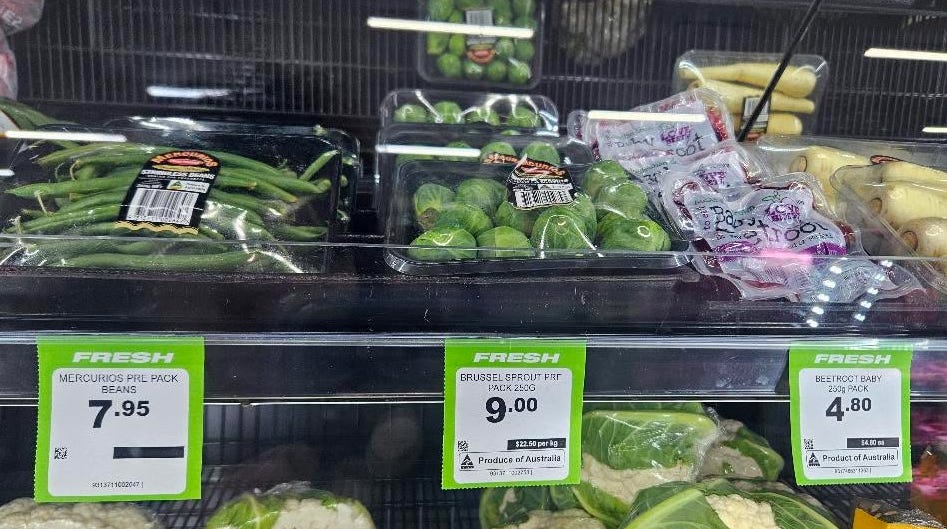
Check out the price on these prepacked Brussel Sprouts…$9 for 12! If that isnt enough to make your hair curl, look closely at the price tag; it says $22.50 per kilo – BUT if they’re $9 for 250grams, that equates to $36 per kilo
His caravan was old and smaller than our bus.
He had heard of us, watched a few podcasts, and wanted to know what to do.
He was a single father and in his van his four-year-old son needed to be schooled.
He wanted to do home schooling, but he himself was not that well schooled and so he wondered how he would do this. Also, with little money in reserve, he admitted that he was one economic disaster away—like a head gasket going, or the caravan’s axle snapping—from them both being homeless, or having his boy taken away.
At some point he would have to work, but who would look after his son while he was doing that?
When he opened his caravan’s door, the little boy was on his iPad. He looked a little puzzled by me, but then went back to his screen, as his father whispered, “He’s on the spectrum.”
The boy’s mother had left. She’d found it too hard—that was all the father told me, as we both watched the boy interact with the world via his electronic umbilical cord.
Then we both looked up as the only larrikins who were still refusing to allow the Government to smother their voices—the corellas and the sulphur-crested cockatoos—went crackling across the forever blue sky and across this father’s forever concerned eyes.
In an opshop in Cowell, I asked a volunteer, a woman in her sixties who’d spent most of her life working in or owning pubs, what she thought of the new hate speech laws.
After discreetly looking around to see if anyone could hear, and then despite no one else but me being in the store, she still leaned in and whispered:
“I have never been racist, but this Government is making me racist.”
For she felt that these new migrants were being treated better than us. But she didn’t say how.
Then, when another volunteer came in—an even older lady—she shut up shop and never spoke again.
In an IGA in the town of Cleve, Kelli brought my attention to a small tray of brussels sprouts wrapped in gladwrap. Twelve brussels sprouts for the low price of nine dollars. We took this photo of them, more out of disbelief than anything else. Plus none of the customers in the store then looked affluent enough to pay that amount.
In the town a flag was flying at half-mast. When I asked a local why, they told me to look at the notice below the flag. The notice stated that it was a local woman who passed away and we both thought it was beautiful that the town was small enough to publicly grieve for one of their own.
In a small and busy cafe in the same town we spoke to the owner. She’d owned and operated the cafe for eight years, but it was easier back then, she said.
When we asked her what the main problems were that she was facing now, she said, the cost of living. In order to make a profit she would have to sell her coffees for seven dollars.
But she claimed, with a bittersweet smile, that she couldn’t bring herself to charge that, for none of the locals would pay it.
In any cafe, profits from coffee sales are—or were—the main profits.
She then went on to talk about all the staff costs, not just the wages, but the workers compensation, sick pay, insurances and more. Plus her rates had doubled.
So when I asked her how much profit she was making, she told me her daughter had asked her the same question just a few nights before.
Her answer; she made less money than her staff, and she didn’t see any way to change that moving forward.
“But aren’t small businesses like yours the backbone of the economy?” I asked. But instead of a replying, she just offered us that same, weary, bittersweet smile.
Then I asked her what she thought of the news that the new subcontinent migrants, who were buying most of the businesses going up for sale in these towns, were reportedly paying some of their staff—most of whom were here on working visas—wages as low as $10 an hour.
It was now that her smile wavered.
We had been told by locals in other towns that these new subcontinent migrants were receiving government grants, and by putting these grants together they were buying these businesses.
But despite getting online and asking the public for evidence, and doing some research ourselves, we have found no such evidence of this.
We did have scores of angry people claiming they knew, and that the grant system was rife and corrupt, but as said previously, not one shred of proof.
And yet, as many of these businesses owned mainly by white people were facing the end, the migrant-run businesses were surviving.
This made me wonder whether it wasn’t so much a question of initial funding, but evolution.
Errol and the Inidan Landord.
After decades of abundance Australians have become individualists. We tell our children to follow their dreams, to carve out a life. But these other cultures, who have not experienced this wealth, have survived in their countries by working together in tight family groups. The Vietnamese did the same when they came over, the Italians and the Greeks when they first arrived.
But in those days, it was possible to make a good living alone. Now though, as we head into what could be a great depression, or worse, are they simply better suited to economically survive?
“They only hire their family or their own,” people tell me, their tone full of spite. “And they don’t abide by our standards.”
But why should they hire us, and why should they follow our standards, if our standards aren’t economically viable?
What if they are simply economic rationalists?
No profit, no business.
Next to where we are staying, B-doubles keep growling past, each of them either full of grain or heading back inland for another load.
One farmer told us that the regulations are so strict on these trucks that the trucking companies need to replace them every few years. If this is true then surely that would consume a huge portion of the trucking companies’ profits.
Perhaps instead of learning to hate these new migrants who are purchasing these dying businesses, we should start learning from them.
We see this with the goats and kangaroos populating all the roads heading into and out of Broken Hill, these long highways cutting through the deserts.
For every kangaroo you see, you’ll see a thousand goats, yet nearly all the roadkill is roos. You hardly ever see a dead goat.
Evolution, be it natural or economic, has no ear for sentimentality. It just rolls on and buries those who can’t keep up in the cluttered sands of time.
And economic evolution is here. It’s been driven by forces beyond our control and it seems it’s not only being protected by our Governments, but driven by them.
And if you want to see this in real time, check out the homeless haunting many of these towns. They are in tents billowing under the bridges, or in the local parks beneath council signs that declare No Camping. A few of these homeless people are indigenous, but the vast majority are white people. None of them are Indian or Pakistani.
They are all working.
So if we don’t learn to adapt, then how will this movie end?
Perhaps, if we could, we should go back in time, and ask a certain flightless, chubby bird who once stood on their island’s shore and watched as the Portuguese ships dropped anchor.
He was a wool classer, and his face—thanks to all the wrinkles and his sharp yet interested eyes—looked like a warm map, one you wanted to follow.
He talked about Australia as if it was in his past.
“It’s gone,” he said. “What we thought it was is gone.”
But he also liked the Indians. “I talk to them,” he said. “They’re good people. Hard-working people.”
One young man in a remote garage told him that where he came from, in India, life was very tough, but here he was earning more in a day than he would earn in weeks back home.
“Do you mind if I ask you how much you earn?” he’d asked this young man.
“Ten dollars an hour” was the reply and he was happy with this.
And he shoudl be, for it was just enough to buy twelve brussels sprouts in Cleve.
Michael Gray Griffith
Cleve South Australia 5/02/26
Discover more from Cafe Locked Out
Subscribe to get the latest posts sent to your email.
Thankyou. This was awesome. I was whining how Australia is gone. I don’t think the government helps or gives a shit but after reading this and thinking about it, it’s our own fault. Australians have become lazy and dumb. We lose the Australia we loved, that’s on us. After the COVID crap, I lost all faith in the Australian citizen. Ready to throw their neighbour under the bus and give up all freedoms just to fit in or think that by complying to lies and bs they will get their comforts back. Well sucked in to them! I like the Indian people too. I’ve worked with plenty. I was feeling peeved that these immigrants keep buying up all the businesses but you made me look from your perspective and I have to agree. Learn and swim or sink and drown! Simple really.
Yep – we deserve what’s coming
Yes Michael, it’s sad wherever I travel, or have travelled. I finally pulled the pin and found a property, bought a caravan, and now to sell the Coaster. Fuel is too expensive for being on a pension, and continually moving. And just in case mechanical issues. I’m safe, and out of harms way. If you are ever near Mt Kanigan, the view is to die for. Qld that is. Safe travels and keep doing what you are doing, you and Kelly are an inspiration. Much love and respect 💝
Thanks Michael beautifully written that conveys where we are heading should be compulsory reading for all Aussies.
Great points.
Yes the families work together – I tried that with my nephews and niece – it was the girlfriends who wanted more – there was no team work – they didn’t want him to work on the land – they wanted to go for coffees and sit in cafes and save up and by their own house
They couldn’t see how they could save money and work together – I was not their family – I was part of his family – I am a woman who has worked a couple of jobs – paid mortgages and went to uni as an older student – I had worked to get several income streams and rented out the spare room in my house
I didn’t spend money on luxuries – didn’t buy fancy sheets and doona covers – glasses and all those extra things – it didn’t work – I can’t live on the land and create community – the young ones have jobs and think that’s all they can manage – they have overseas holidays and flash cars – the expensive hair appointments and the up to date technology – they don’t want to buy from farmers makers and buy processed foods – they resent hearing any other way – they see so spoilt and entitled most of them and they have rights – and the way the laws are having anyone live on your land is a risk – I tried to create community – I am not perfect and accept 59% of the blame for things not working trying to create community – I love indian people – it’s amazing they are the only ones getting the bad press – when there are just as many if not more Chinese – why don’t they get mentioned ? The Indians have a spiritual life and beliefs that’s gentle and deep – they are hard workers and they do network amongst themselves – everyone does except for the those who established this capitalist country – we are called racist if we do !
As a teacher, I’ve watched migrant families move to this country and the kids can barely speak English. Many of the families moved here for work in the local meat works (I live in the Beef Capital of Australia). By the end of the school year, many of the migrant kids have achieved better results than the Aussie kids because they worked at it, and appreciated the opportunity on offer, while Aussie kids continue muck around or make life extremely difficult for me and the rest of the class. They don’t care about education because, as one Year 8 lad told me, all he wants to do is sit and watch movies all day as his brothers, dad and grandad did. Third generation welfare. Laziness and contempt. This is what a handout mentality breeds.